
Affordability, Debt and the Silent Tax of Currency Debasement
Let's get a little political, in an attempted non-political way. The end of May will be the onset of the mid-term election season. I expect the national rhetoric to go off the charts, and despite the recent failed attempt at redrawing our Congressional district in Northwest Indiana, I think we can expect an actual contest here in the Region as well, as apparently the national Republican party feels done with writing off Indiana's first district.
It's clear at this point that some political focus group somewhere coined the word "affordability" as a rhetorical way of addressing the inflationary pressures present in the U.S. economy. With this new winning word in hand, politicians around the country have been playing this fiddle until the strings fall off. The political oracles from both sides all claim to deeply understand the "affordability" crisis and promise to do something about it.
I'm not sure -- and am not sure anyone else is sure -- what this vague word really means, but with an educated guess I think the closest context is that it is being used to describe the trend of prices in goods and services going up faster and more aggressively than the income people earn, receive from pensions or receive from the government.
Recent notable examples in my own life: my obscene health insurance renewal (up 30%), my homeowners insurance renewing up 15% despite no claims, my NIPSCO bill arriving at what seemed like twice what it should be, the $125 it took to fill my truck with gas last weekend, and the $4 cup of coffee I am drinking while writing this column. Combine this with the anxiety my second daughter is experiencing because she doesn't feel she can afford a first home despite both her and her husband having good post-grad jobs, and I am able to appreciate the context of "affordability" as an actual thing.
The Debt Behind the Word
With this painful understanding in hand, let me scroll down the list of politicians or political parties who can solve this problem. You already know where this is going, which when summed up simply is: not likely. Reality of course is much more complicated.
The U.S. Federal debt has now hit $39 trillion. Interest on the debt is expected to hit $1 trillion in 2026, comprising 17% of Federal spending and more than every other cost except Social Security and Medicare. In order to sustain this level of interest expense, the Federal government is expected to borrow an additional $1.9 trillion in 2026. If the government was a family, it would be opening new credit cards to pay the interest on credit cards it had already maxed out. Yeah, it's that bad.
The Third Option: Currency Debasement
There were a couple of options for the government to address this terrible math. The government could have theoretically attempted to spend less or attempted to tax more, but at this point in the debt cycle neither was likely to move the needle much, and neither was seriously entertained. Instead, as someone who watches the markets and the economy, a third option seems much more likely. The third option is called currency debasement, and I am not alone in this expectation.
Diving deeply into the mechanics of how currency debasement policies are conducted is beyond the scope of this column, but the net effect is to make it easier for the government to pay back the dollars it owes, by making dollars themselves less valuable. We used to call this inflation. Apparently, "affordability" plays better in focus groups and campaign ads.
What This Means for Your Financial Decisions
In the financial modeling and planning software we use, inflation works in a straight line -- 2.5% a year, every year. For the first couple decades of my career my clients hardly noticed inflation; in fact, a lot of things were getting less expensive over time. Having experienced the last five years, however, I have come to appreciate inflation as much more "spurty." Trends such as globalization and advancements in technology can tend to lower the cost of goods over time, which then provides more leash for the government to mismanage itself. And mismanage itself it has. The chickens have come home to roost, and it is being called affordability.
Sustaining a period of currency debasement requires deliberate personal financial decision making. How we choose to spend and borrow, how we choose to save and invest, how and when we choose to utilize our accumulated wealth to benefit the next generation. The answers provided by politicians are, in my opinion, only likely to make the issue worse. The real answers will come from ourselves. We will continue to explore.
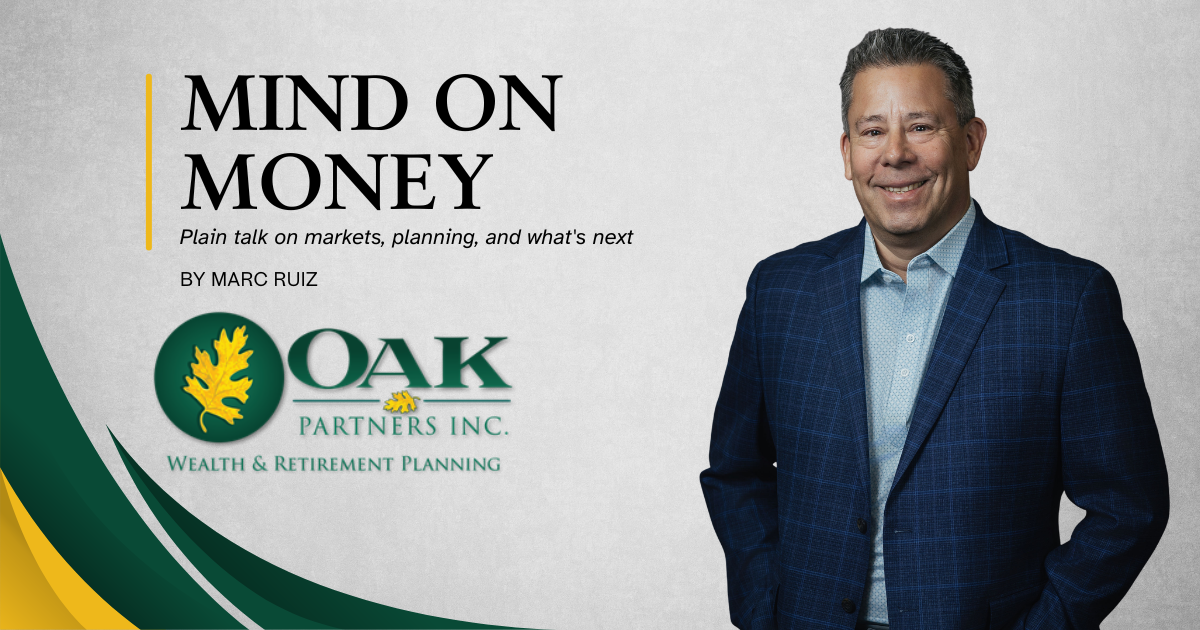
The opinions voiced in this material are for general information only and are not intended to provide specific advice or recommendations for any individual. Marc Ruiz is a wealth advisor and partner with Oak Partners and registered representative of LPL Financial. Contact Marc at marc.ruiz@oakpartners.com. Securities offered through LPL Financial, member FINRA/SIPC.