Expect Boomers to disrupt elder care
I've spent my entire career providing advice, investment management and financial services to the Baby Boomer generation. While not a Boomer myself, the entry point of my career in 1993 seems to have been perfectly timed to serve this largest-ever generation, and for me, the Boomers have provided the perfect foundation for me to develop and refine my planning and advice skills. Unlike those pesky Millennials who like to tease our Boomer friends, the Boomers have been my most trusted clients and friends for decades (OK, sometimes I tease the Boomers too).
The Boomers have approached life in a unique way from the moment they emerged on this earth. In my experience, this generation born between 1946 and 1965 is skeptical and innovative and has been disruptive in every stage of life. As the first Boomers began entering retirement roughly 15 years ago, they of course changed the nature of retirement as well -- retiring on unpredictable schedules, remaining growth-oriented investors into retirement, sometimes returning to work after "retirement" and spending their 60s with epic travel, new homes and in typical Boomer style, spending money like they have it (and they do).
I expect my observed core Boomer culture characteristics of questioning and disruption to follow them into the aging process as well. With the oldest Boomers now almost 80, I am having more and more conversations in my practice about long-term care planning, and the advice we are providing in this area has a distinctly Boomer flavor.
Previous iterations of long-term care planning centered around asset preservation strategies, with a focus on sheltering family assets from being spent on "nursing home" costs and qualifying individuals for public long-term care benefits. Families perceived the nursing home as "taking" all their assets and leaving them broke, and in an attempt to address this unpleasant perception, families would put planning in place to pre-emptively make themselves "broke" in order to qualify for government benefits.
Prior iterations of long-term care planning also had the benefit of long-term care insurance. Unfortunately, these products were poorly designed and underwritten and most insurance companies have exited this market or positioned their remaining products as extremely unattractive. Even existing long-term care insurance policies have not functioned as originally presented, and have across the board increased premiums dramatically or in many cases reduced benefits over time.
Bring on the Boomers. Just as the Boomers have disrupted every other aspect of society as they moved through it, I expect them to disrupt aging and elder care. While members of the generation before them were more likely to have ample retirement income derived from pensions but perhaps limited liquid assets, the Boomers came of age during the era of the 401(k) and tend to have less pension-based retirement income but more in the way of retirement assets in the form of liquid investments.
In addition, while the security-focused generation before them may have stored most of their liquidity in slowly appreciating savings accounts and CDs, the Boomers tend to store their liquidity inside retirement accounts invested for growth. So going into their elder years, Boomers may have less structural retirement income to be used for care needs, but they also tend to have much more liquidity -- and liquidity means flexibility.
These structural financial changes are having distinct implications for the way Boomers think about long-term care planning as well. Instead of a focus on asset preservation and accessing the security of government benefit programs, the Boomers in my practice are intensely focused on preserving choice and independence as they age.
In response, elder care models and even public benefits programs are evolving. The availability of home-based care, the emergence of lifestyle-focused senior support communities and the expanded services provided by assisted living centers have changed the way Boomers view aging. Less frequently are the Boomers I work with perceiving elder care simply as nursing homes "taking their money" -- more often they view aging as another lifestyle change to be met on their terms, through an experience they seek to control. And they are willing to use their assets to maintain this control.
Like most topics in the column, the earlier this type of planning discussion is conducted, the more options we can develop to address each family's unique concerns. With the Boomers just now entering their octogenarian years, I expect many disruptions ahead for elder care, but one trend I do not expect to change is the Boomer culture of independence and disruption following them into this unique stage of life.
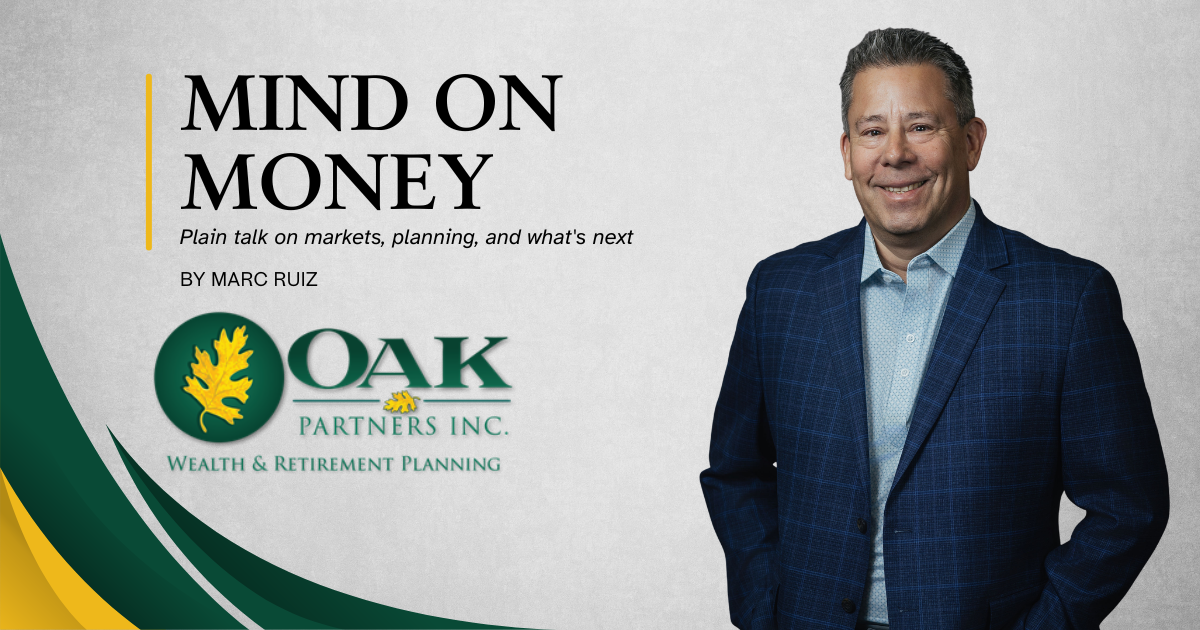
The opinions voiced in this material are for general information only and are not intended to provide specific advice or recommendations for any individual. Stock investing includes risks, including fluctuating prices and loss of principal. No investment strategy can guarantee a profit or preserve against loss. Past performance is not a guarantee of future results. Marc Ruiz is a wealth advisor and partner with Oak Partners and registered representative of LPL Financial. Contact Marc at marc.ruiz@oakpartners.com. Securities offered through LPL Financial, member FINRA/SIPC.