
Managing political bias when making investment decisions
I listen to a lot of podcasts. Podcasts in the car, podcasts in the shower, podcasts while I am brushing my teeth. If I get any "me time," which is kind of rare, I am likely listening to a podcast.
I find the podcast format appealing because I like the length and depth of conversations, without the constant need for soundbites and without the ever-approaching commercial break. I also like the podcast format because everybody is doing one. Conservatives, liberals, libertarians, socialists, scientists, investors, economists, conspiracy theorists, historians, relationship coaches, survivalists -- you name it, and someone online is talking about it. I love the perspectives and yes, I love the debate.
One feature of the modern podcast universe is the full transparency of bias. No one hides their bias in a podcast. No one pretends they are a dispassionate journalist, while really spewing propaganda and talking points. The bias in the podcast world is on open display, and it helps the listener know where they stand, which is certainly not the case with other forms of media (including this one). To me, the open display of bias makes all the difference.
As a columnist, I try not to hide my bias as well. I am a philosophical libertarian. I believe government is often an inadequate and expensive delivery mechanism for many of the important functions it attempts to provide, and I believe the bigger the government, the less effective the local result tends to be.
I believe in communities taking care of their own, especially our most vulnerable, and I believe a system where the Federal government takes 20% of the income created in our communities to be wrangled over in a dysfunctional city 1,000 miles away and then partially sent back with strings attached is kind of, well, insane. I don't often vote Democrat, but I have at times, and I have little illusion about the instinctual governing style of Donald Trump. There's my bias, laid out for all -- many of you may not align with me but we can still be friends.
When it comes to investing however, or more importantly, advising others on their investing, to the greatest extent possible the bias must be managed. Politics is politics and markets are markets, and while both get a lot of attention and can sometimes seem as one, in my opinion, the two are distinctly different from an investing decision-making perspective.
So, where am I going with this? In hindsight, the philosophy behind "Bidenomics" is becoming clear. My perception is federal economic policy under the last administration consisted of a combination of a high comfort level with extreme deficit spending, using these deficits to fund massive public sector hiring to support employment, and driving public funds toward preferred industries such as green energy, semiconductors and NGOs supporting progressive causes. From a political and economic worldview perspective I agree with none of these policies, and yet my business and my own financial planning required me to navigate through this activity in an attempt to manage financial risk and hopefully find investment gains.
The new administration has taken a distinctly different approach. In an effort to control deficit spending it has embarked on a road to government austerity (DOGE), is attempting to raise government revenue through tariffs as opposed to increased income taxes, and is focused on across the board deregulation across all industries, particularly energy production.
Maybe the way these policies are being presented in the press make them seem more radical or dramatic, and daily Trump rhetoric coming out of the White House doesn't help, but when we break these policies down into a basic form, there's nothing here dragging us off the economic cliff.
Now, here's the rub. For those who are pre-disposed against Donald Trump, and there are many, you can despise everything I just said, its your right as an American. You can blame the stock market volatility on Trump, and you can say "I told you so."
The truth, however, is rarely so black and white. Reality is, by nearly every metric I follow the stock market going into 2025 was overvalued and likely due for a correction. Yes, the tariff conversation may have induced the correction process, but to make the volatility all about tariffs is an oversimplification.
So, my advice is this. Be very careful about tapping into political bias when making long term financial decisions. Yes, now is the time to be an active investor, manage risk, try to find opportunity, but please don't let the blood sport of politics and the inflammatory rhetoric of Donald Trump and cable news completely disrupt long-term investing and financial plans.
Despite all the prior claims otherwise, the world didn't end under Joe Biden and the smart money says it won't under Donald Trump. Be part of the smart money crowd.
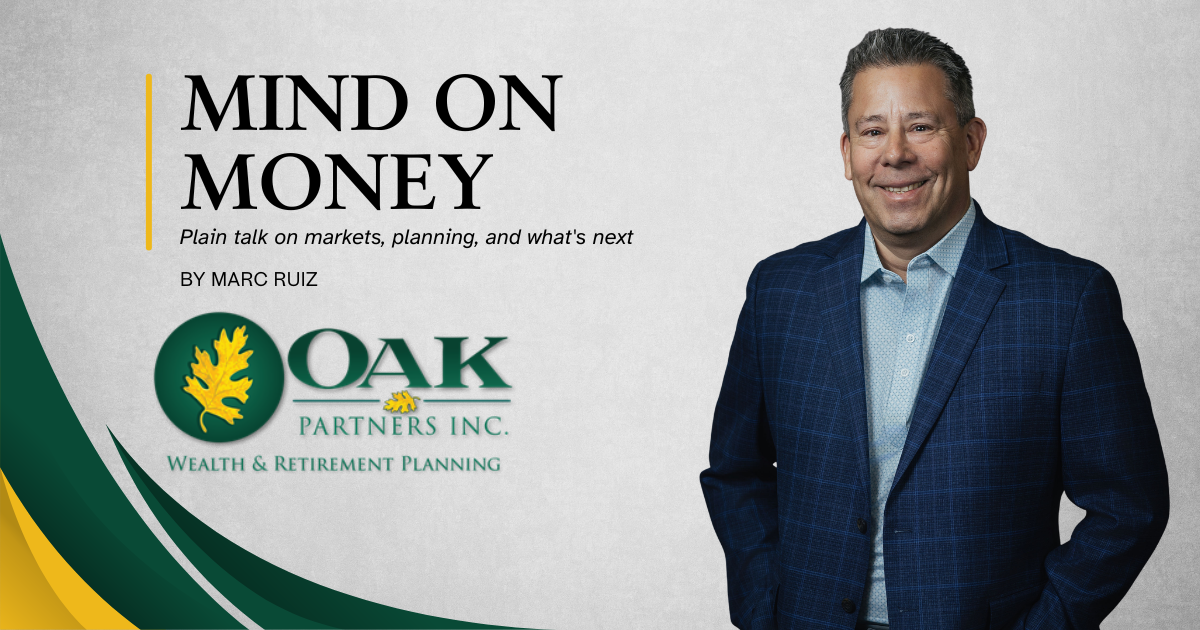
The opinions voiced in this material are for general information only and are not intended to provide specific advice or recommendations for any individual. Stock investing includes risks, including fluctuating prices and loss of principal. No investment strategy can guarantee a profit or preserve against loss. Past performance is not a guarantee of future results. Marc Ruiz is a wealth advisor and partner with Oak Partners and registered representative of LPL Financial. Contact Marc at marc.ruiz@oakpartners.com. Securities offered through LPL Financial, member FINRA/SIPC.